


Reflection
Welcome to my Handbuilding I TA reflection page! I spent all semester (except maybe 5 class periods) helping Allison Ford's Beginner Handbuilding class! I did everything from teaching them how to wedge for the first time, to explaining glaze combinations in the kilns.
Early Classes
In early classes, the students were quiet just like any freshman-sophomore class is at the start. I was surprised that over 2/3rds of the class were actually art education majors. There was even a student who said directly that they hated clay, and were just taking the class so they could help their students learn the medium if they want. A challenge, but nothing my daily comedy routine couldn't handle.
The students were visibly nervous, so to try to ease that nervousness I tried to crack jokes whenever I could, work on projects right alongside them, and of course used their lingo (6-7). This genuinely helped, along with me trying to make myself seem approachable and kool with the students, and just like that they started lightly chatting with their neighbors, asking questions, and exploring clay a little more comfortably.
Middle of Semester
Things are starting to ramp up a bit! Students were given assignments like making test tiles, making cups using 3 different building techniques (slab, pinch, coil), and making actual working chia pets from a chunk of clay, and then cut it in half and carved it out.
I even gave a lecture on glazes in general, because glaze is something I have devoted a lot of energy towards learning, and Allison wanted to put my lecturing skills to the test! In the future, I would've forced everyone to come to the computer lab to sit instead of trying to beckon them over to listen to me. Some students were just working on their projects, so they were losing important information about glazes. I would've also had more physical examples of some of the stuff I was talking about (reduction vs oxidation, glaze malfunctions, physically glaze a piece in front of them, wipe those bottoms!).
Students started making truly ambitious projects that even I would be nervous making right now - but I am so happy that they felt comfortable enough to ask for help when making their projects. It was a learning curve for everyone, but with the amount of unique projects being made, everyone was learning from each other and not just the professor and I. Some students even started making real friends in the class, changed their major to ceramics, and felt comfortable chatting while also working!
End of Semester
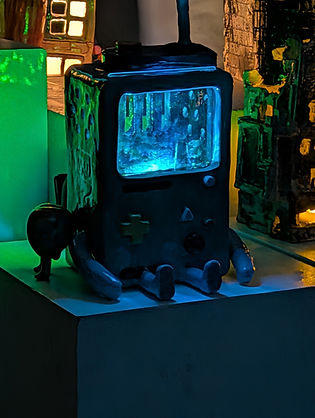
Dun dun duuuuun. End of semester. Everybody is going crazy. We made them make a 'light abode' project - a piece that could house something, and also have light interact with it in some way. These projects were huge, slab built, and took a lot of trial and error. Students got to learn the harsh reality that clay cannot be rushed, it needs proper time considerations. Slabs cracked, pieces blew up, sections warped. We made them earn their architecture certificates with this one, but they still persevered and made amazing and creative houses like a turtle with its shell being removable, BMO from adventure time, and even a run-down graffiti 3 part housing structure.
Between the the house project and final project, I gave them a demo on overglaze and china painting - which went so much better than I had hoped. I brought in supplies for students to look at and play with, example pieces, books, and I even made kits for students to try it out for themselves afterwards. I even got a laugh while I gave my demo!
Finally, they had a project to make a coil-built, 21 inch minimum vessel inspired by a moment in ceramics pre-1900s, that also combined something that connected it to themselves in a way. They even had to make a mini raku piece that connected to the main piece! I loved seeing who they were personally as well as pieces they gravitated towards in the historical ceramics context. Students got to use the spray booth, and they learned the beast that is "oh so I have to wait a day between every few coils or else the piece will slump and fall apart?". Yeah. It was hard. Drying time was also hard for students to realize - when we say it will take a week or 2 for pieces to dry enough to go in a kiln with a 6 hour hold, we meant it. Some students pieces blew up because they didn't understand the drying process enough and rushed through it. One student even forgot to wipe the bottom of their piece... at week 15.
Final Thoughts
All in all, the class was a dream to work with. I couldn't have asked for a better class to get me into teaching. They pushed my technical skills, knowledge, and even my patience sometimes... But nonetheless, we all got through it together, laughs included.
In the future when I teach a beginner class, I think I would really hammer in the foundations of ceramics - use your rib to compress, wipe off the bottoms and leave space around the edges so no glaze runs, and work backwards from critique. I would also (unfortunately for them) make them learn the elements and principles of design, and use that to help make critiques more informative and helpful for them. Being able to talk about why a piece is or isn't working is imperative at the foundations level, and I want them to be the cool kids in their ceramics 6 class being able to understand why a piece is good or not.
Getting students to turn in images or assignments is always hard. I think having exit tickets on thumbnail sketch days and critique days where they physically take photos of their work and submit them to canvas will help me be able to grade their pieces, and it will also feel so much better for them to have their stuff done!
